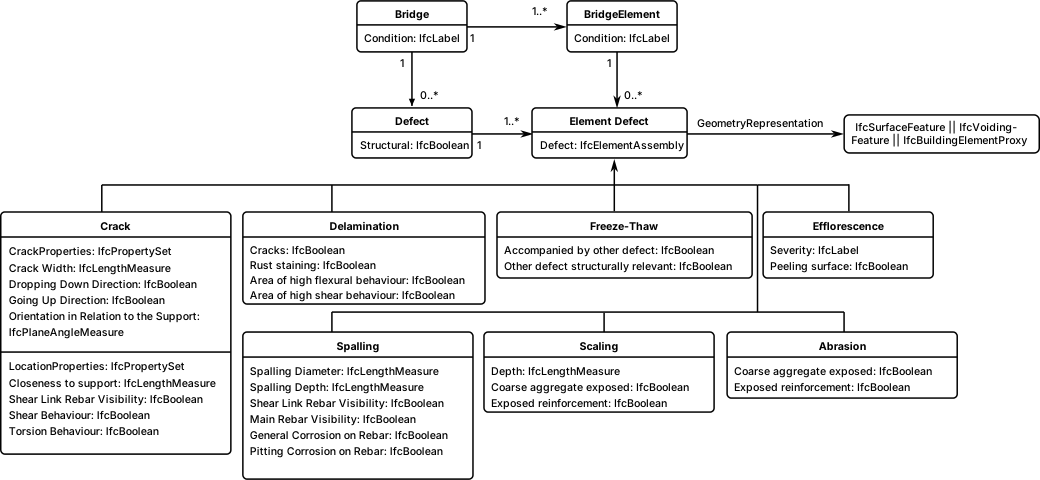
Conducted during my Master’s studies in Digital Engineering at the Bauhaus-Universität Weimar, this student project investigated the extension of Bridge Information Modelling (BrIM) into the Operation and Maintenance (O&M) phase using the Industry Foundation Classes (IFC4 / IFC4x2) open data standard [1], [9]. Bridging the documented gap between design-stage BrIM and O&M information management [2], [3], multiple hypothetical geometric and image-based modelling workflows for three primary defect categories were developed as proof of concept and compared for demonstration: concrete spalling, outer surface structural cracking, and material degradation [1]. For spalling defects, a close-range photogrammetry pipeline was implemented, capturing over 20 photographs of a corroded concrete surface, generating a point cloud mesh in Autodesk ReCap Photo, applying quadric-based edge collapse decimation in MeshLab, and extruding the unioned 3D faces in AutoCAD, to create a high-fidelity void element that cuts the concrete host and exposes corroded reinforcement in Revit and IFC [1]. For structural cracks, three distinct modelling techniques were investigated: (1) mapping URI-linked texture images onto tessellated surface features (IfcSurfaceFeature with IfcTriangulatedFaceSet and IfcImageTexture), following the surface-feature approach of Hüthwohl et al. [8]; (2) embedding portable hexadecimal binary texture blobs (IfcBlobTexture) generated via a custom-built Java binarization tool; and (3) tracing crack photography with an AutoCAD spline to extrude a dimensionally accurate triangular void profile cut directly into the concrete beam [1]. Additionally, localized chemical and physical material changes (such as sulphate oxide degradation) were modelled by aggregating volumetric proxy cubes onto the bridge deck with dedicated material-loss property sets [1].
A rigorous interoperability evaluation across six industry-standard IFC viewers (e.g., Apstex, BIM Vision, XbimXplorer, usBIM, Autodesk Revit, and DesiteBIM) revealed critical insights into the practical capabilities of current BIM software [1]. While the IFC4 schema theoretically supports 2D surface texturing for cracks [8], none of the evaluated commercial viewers could render the actual linked or binary-embedded bitmap textures, displaying only solid-colored rectangular bounding surfaces alongside significantly increased file sizes and coordinate placement challenges [1]. Conversely, 3D volumetric void-cutting approaches, both boolean geometry cuts exported from Revit and direct IfcVoidingFeature cutout representations [3], [8], as well as proxy-based material change volumes, showed high cross-platform compatibility [1]. Viewers such as BIM Vision, XbimXplorer, usBIM, and DesiteBIM accurately rendered the complex 3D spalling and crack geometries while preserving the hierarchical links to inspector details, condition ratings, and quantitative defect properties [1], [5], [8].
Related Tools
- IFC Loader: Open the DIM Demo Project sample with its crack texture dependency
- usBIM: ACCA BIM management system and IFC viewer used in the interoperability evaluation
- XbimXplorer: xBIM toolkit desktop IFC2x3/IFC4 viewer used to inspect voiding features and semantics
- IfcOpenShell: Open-source IFC toolkit and geometry engine for reading, writing, and modifying BIM models
- Bonsai Studio: Native IFC authoring in Blender, built on IfcOpenShell
References
- [1] M. Said Helmy Alabassy, Technical Report on “Special Project for Damage Information Modelling of Bridges,” Chair of Intelligent Technical Design, Bauhaus-Universität Weimar, 2019.
- [2] D. M. Frangopol, J. S. Kong and E. S. Gharaibeh, “Reliability-Based Life-Cycle Management of Highway Bridges,” Computing in Civil Engineering, 2001.
- [3] D. G. Moghaddam, “Framework for Integrating Bridge Inspection Data with Bridge Information Model,” Concordia University, Montreal, Quebec, Canada, 2014.
- [4] M. Nasrollahi and G. Washer, “Estimating Inspection Intervals for Bridges Based on Statistical Analysis of National Bridge Inventory Data,” Bridge Engineering, vol. 20, no. 9, pp. 1–11, 2014.
- [5] FHWA, “Recording and Coding Guide for the Structure Inventory and Appraisal of the Nation’s Bridges, No. (FHWA-PD-96-001),” Federal Highway Administration, U.S. Department of Transportation, Washington, DC, USA, 1995.
- [6] U. F. H. Administration, “2010 Status of the Nation’s Highways, Bridges, and Transit,” 2010. [Online]. Available: https://www.fhwa.dot.gov/policy/2010cpr/chap3.cfm#38a. [Accessed 29 5 2019].
- [7] A. Carriquiry, B. A. Bektas and O. Smadi, “Using Classification Trees for Predicting National Bridge Inventory Condition Ratings,” Infrastructure Systems, vol. 19, no. 4, p. 425–433, 2013.
- [8] P. Hüthwohl, I. Brilakis, A. Borrmann and R. Sacks, “Integrating RC Bridge Defect Information into BIM Models,” Computing in Civil Engineering, vol. 32, no. 3, 2018.
- [9] A. Borrmann, S. Muhič, J. Hyvärinen, T. Chipman, S. Jaud, C. Castaing, C. Dumoulin, T. Liebich and L. Mol, “The IFC Bridge Project — Extending the IFC Standard to Enable High-Quality Exchange of Bridge Information Models,” European Conference on Computing in Construction, 2019.